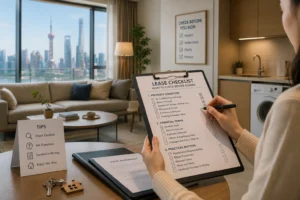


Moving to Shanghai comes down to four decisions that matter more than any others: securing the right visa and enough working capital, choosing a neighborhood that matches your daily life rather than just your budget, evaluating any specific apartment beyond its listing photos, and reading a lease closely enough to avoid the disputes that cost newcomers their deposit. Get those four right, in order, and the rest of the move — SIM cards, bank accounts, police registration — falls into place within your first week. This checklist walks through every stage with real 2026 figures, so nothing about your move has to be a guess.
| Stage | What to Do | Timeline |
|---|---|---|
| 1. Visa & funds | Confirm visa category, gather documents, budget move-in cash | 60–90 days before |
| 2. Neighborhood | Match a district to commute, budget, and family needs | 30–60 days before |
| 3. Property check | Evaluate specific listings beyond the photos | 2–4 weeks before |
| 4. Lease review | Confirm every contract term before signing | At signing |
| 5. Move-in inspection | Document condition, meters, and keys | Move-in day |
| 6. First-week admin | Police registration, bank, SIM, payment apps | Within 24–72 hours |
Before You Arrive: Documents, Visa & Money
Every foreign national moving to Shanghai needs three things confirmed before departure: a visa matched to their actual purpose (work, study, family, or business), a passport valid for at least six months, and enough liquid funds to cover roughly four to five months of rent for the initial move-in. Sorting these in the wrong order is the single biggest cause of a chaotic first week.
Visa Types at a Glance
| Visa | Who It’s For | Typical Duration |
|---|---|---|
| Z Visa | Employer-sponsored work | Converts to a 1-year residence permit on arrival |
| X1 / X2 | Long-term / short-term students | Matches course or program length |
| Q1 / Q2 | Family reunion | Varies by relationship and purpose |
| M | Business or trade | Short-term, sometimes renewable |
Work permits are graded A, B, or C using a points system based on age, education, salary, and Chinese-language proficiency. The grade affects processing speed and, years down the line, eligibility for permanent residence — fewer than a few thousand foreign nationals receive it annually.
What to Have Ready Before You Fly
- A passport with six-plus months of validity and blank visa pages
- Scanned copies of your visa, admission letter, or work documents saved to cloud storage reachable without a VPN
- A flexible, short-term accommodation booking (coliving room or serviced apartment) for your first one to three months, rather than a 12-month lease signed sight unseen
- A working payment plan: Alipay linked to an international Visa or Mastercard covers most day-one spending even before you open a local bank account
Budget checkpoint: plan for roughly four to five months’ rent in accessible funds to cover your move-in — first rent period, deposit, and a one-time agency fee. For a mid-range one-bedroom in central Shanghai, that typically lands between CNY 28,000–45,000 (about USD 3,900–6,300).
How Much Does It Actually Cost to Move to Shanghai?
A single professional can live comfortably in Shanghai on CNY 10,000–15,000 a month (about USD 1,400–2,100), rent included, while a couple should plan for CNY 14,500–21,000 combined. That’s typically 40–60% less than an equivalent lifestyle in London or New York — though prime districts like the Former French Concession and Lujiazui narrow that gap considerably.
First-Month Setup Cost
| Item | Typical Cost (CNY) |
|---|---|
| First rent period (often 1–3 months upfront) | 7,000–21,000 |
| Security deposit (1–2 months) | 7,000–14,000 |
| Agency fee (35–100% of one month’s rent) | 2,500–7,000 |
| Furniture and setup essentials | 2,000–6,000 |
| Total to move in | ~28,000–45,000 |
Monthly Budget by Lifestyle Tier
| Category | Student | Young Professional | Couple (combined) |
|---|---|---|---|
| Rent | 3,000–4,500 | 5,500–9,000 | 8,000–12,000 |
| Food | 1,500–2,000 | 2,500–3,500 | 4,000–5,500 |
| Transport | 150–300 | 200–400 | 400–600 |
| Utilities & phone | 150–300 | 300–500 | 500–800 |
| Going out | 500–900 | 1,300–1,800 | 1,200–1,800 |
| Realistic total (CNY) | 5,500–8,000 | 10,000–15,000 | 14,500–21,000 |
Shanghai vs. Western Cities
| City | Full Monthly Budget, Single (USD) |
|---|---|
| Shanghai | 1,100–1,900 |
| Paris | 2,300–3,000 |
| London | 2,800–3,800 |
| New York | 4,200–5,500 |
Choosing Where to Live: A Neighborhood Fit Checklist
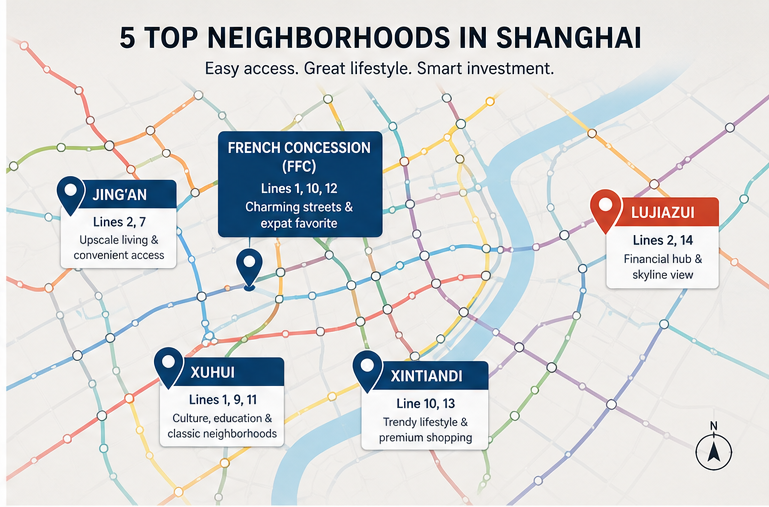
 The right Shanghai neighborhood depends on three factors, in order of importance: where you work, your monthly housing budget, and whether you have children. Jing’an offers the strongest transit connectivity for most commutes; the Former French Concession and Xuhui offer the strongest lifestyle and walkability; Lujiazui suits finance professionals minimizing commute time; and Changning/Gubei is the default for families prioritizing international schools.
Match Your Priority to a District
| If Your Priority Is… | Consider |
|---|---|
| Shortest, most flexible commute | Jing’an (Lines 2, 7, 12, 13, 14) |
| Walkable, café-lined lifestyle | Former French Concession, Xuhui |
| Working in finance or Pudong | Lujiazui |
| International schools and space | Changning, Gubei, Jinqiao |
| Lower rent, still reasonably central | Northern Jing’an, Hongkou, Yangpu |
Five Districts at a Glance
| District | Vibe | 1-Bed Rent (CNY/mo) | Best For | Main Trade-off |
|---|---|---|---|---|
| Former French Concession | Leafy, café culture, historic lane houses | 7,000–18,000+ | Lifestyle-first movers, couples | Older buildings, premium pricing |
| Jing’an | Central, best-connected | 5,000–15,000 | Professionals wanting one central base | Northern Jing’an is less polished |
| Xuhui | FFC feel, better value | 4,500–12,000 | Value-seekers who still want walkability | Quality varies block to block |
| Lujiazui (Pudong) | Modern towers, skyline views | 6,000–20,000+ | Finance professionals | Feels sterile; crossing the river costs real time |
| Xintiandi | Polished dining and nightlife | Premium | Social, dining-focused renters | Less residential, more tourist-adjacent |
Puxi or Pudong?
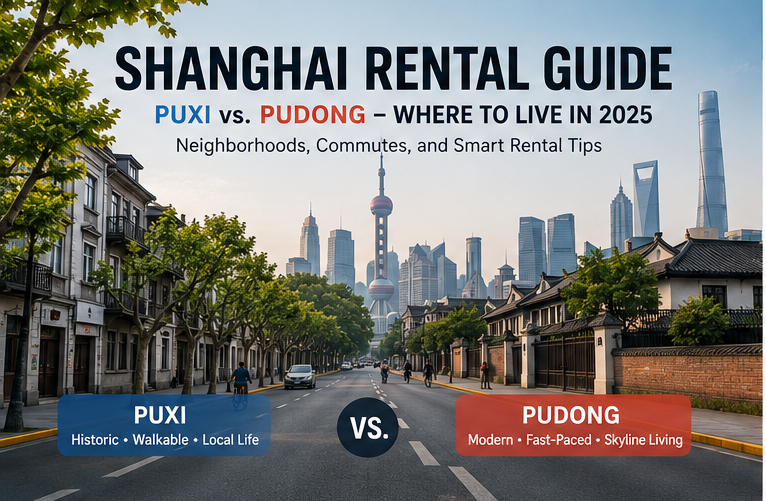
Puxi (Jing’an, the Former French Concession, Xuhui) is denser, older, and more walkable. Pudong (Lujiazui) is newer, greener, and the better call if your office is already on that side of the river. The two are only 15–20 minutes apart by metro, but they feel like different cities.
Evaluating a Property Beyond the Photos
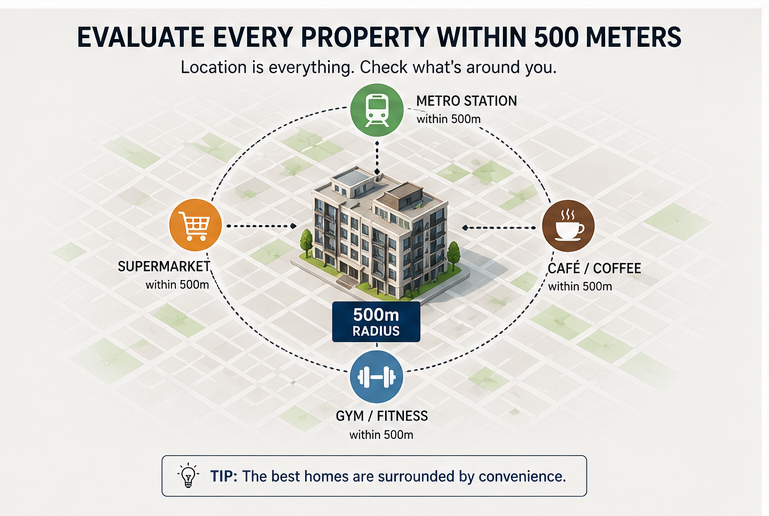
Listing photos and rental price tell you almost nothing about daily livability. Before committing to any Shanghai apartment, test the actual commute at rush hour, walk the surrounding 500 meters on foot, and check noise, natural light, and existing damage in person rather than over a video call whenever possible.
The Commute Test
Do the actual commute, at the actual time you’d travel it, before signing. A route that shows 18 minutes on a map can become 35 minutes once you add a transfer and a 10-minute walk at each end during rush hour.
The 500-Meter Checklist
- Nearest metro station and real walk time — not straight-line distance
- A supermarket or wet market within walking distance
- At least one café or casual restaurant nearby
- A gym or fitness option within a reasonable radius
- A pharmacy and a convenience store (FamilyMart, Lawson, or 7-Eleven) for late-night basics
For Families
Add the school-run distance and traffic pattern, a park or green space within walking distance, and whether the building or compound allows children in shared areas without restriction.
Red Flags to Walk Away From
- The landlord can’t produce the property ownership certificate (fangchan zheng) or a matching ID
- Pressure to pay or sign the same day (“another viewer is coming this afternoon”)
- A request to send deposit or rent to a personal account with no written authorization
- A contract only in Chinese, with no time offered to have it translated
Before You Sign: Lease Checklist
A legitimate Shanghai lease is bilingual, names the landlord exactly as they appear on the property ownership certificate, and explicitly states the deposit amount, return timeline, and permitted deductions. If any of those three things is missing, don’t sign yet.
What the Contract Must Include
| Clause | What to Confirm |
|---|---|
| Parties | Landlord’s name matches the ownership certificate exactly |
| Term | Start and end date, typically 12 months |
| Rent & payment | Amount, due date, payment structure |
| Deposit | Exact amount, return timeline (often 7–14 days after move-out), allowed deductions |
| Maintenance | Repair threshold — who pays below vs. above a set amount (often around CNY 500) |
| Utilities | Which party pays water, electricity, gas, and management fees |
| Early termination | Diplomatic/break clause terms, if negotiated |
Deposit & Payment Structure
The classic structure is “pay three, deposit one” — three months’ rent upfront plus one month’s deposit — though many landlords in expat-heavy buildings now accept monthly payment at a small premium. Agency fees typically run 35–100% of one month’s rent, paid once at signing.
The Clause Most Newcomers Forget
If there’s any chance your employer relocates you or your visa status changes, negotiate a diplomatic (break) clause before signing, not after. A typical version allows termination after 12 months of a 24-month lease with 30–60 days’ written notice, usually tied to proof such as a termination letter or visa cancellation.
Move-In Day: The Inspection Checklist
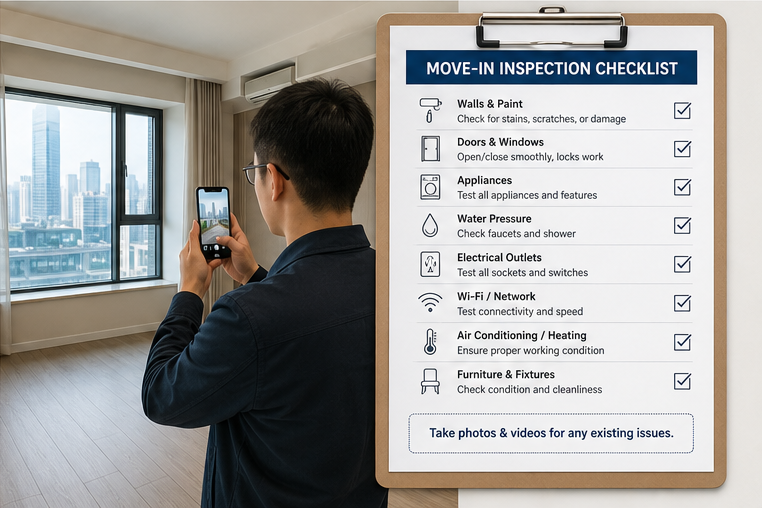
Your move-in inspection is your main real protection for getting your deposit back at the end of the lease. Walk every room with the landlord or agent, test everything that plugs in or turns on, photograph existing damage, and get the condition report signed and dated before you accept the keys.
Room-by-Room List
- Air conditioning — heating and cooling mode, in every room
- Water pressure and hot water, in the kitchen and bathrooms
- Windows and doors open, close, and lock properly
- Appliances: fridge, washing machine, water heater, stove
- Walls and floors — photograph any existing cracks, stains, or scuffs
- Furniture and appliance inventory list matches what’s actually in the unit
Document Everything
Take dated photos, and ideally a short video walkthrough, of any pre-existing damage, and share them with the landlord or agent the same day. A timestamped message is often enough on its own to resolve a deposit dispute months later without argument.
Utilities & Keys
Record and photograph the starting meter readings for water, electricity, and gas so you’re never billed for a previous tenant’s usage. Confirm you’ve received every key and access card: building entrance, elevator fob, apartment door, and mailbox.
Your First Week: Registration & Settling In
Chinese law requires every foreign national to register their address with the local Public Security Bureau within 24 hours of moving in. Hotels handle this automatically at check-in; in a private apartment, it’s your responsibility — and most Shanghai districts now offer same-day online self-registration.
Quick-Reference First-Week Tasks
- Police registration within 24 hours (bring your passport and the signed lease)
- A local SIM card (passport required at any China Mobile, Unicom, or Telecom store)
- WeChat and Alipay set up, with a foreign card linked
- A bank account — optional in week one, but it makes salary and refunds easier; you’ll need your passport, residence permit, and sometimes an employment letter
Frequently Asked Questions
What should I check before signing a lease in Shanghai?
Confirm the landlord’s ID matches the property ownership certificate, and get the deposit amount, return timeline, and maintenance threshold spelled out in writing. Insist on a bilingual contract — the Chinese version legally prevails, so you need to actually understand what you’re signing.
How much does it cost to rent an apartment in Shanghai as a foreigner?
A one-bedroom typically runs CNY 5,000–15,000 a month depending on district, plus a one-time agency fee (35–100% of one month’s rent) and a 1–2 month deposit. Central districts like the Former French Concession and Lujiazui sit at the higher end; Xuhui and northern Jing’an offer better value.
Which neighborhood is best for expat families in Shanghai?
Changning, especially the Gubei area, and Jinqiao in Pudong are the top choices, thanks to their concentration of international schools and green space. Xuhui and the Former French Concession also work well for families who prefer walkability over suburban space.
What documents do I need to rent an apartment in Shanghai?
You need a valid passport and, in most cases, your visa or residence permit. After signing, your landlord must register your residence with the local police within 24 hours, which also requires your passport and the signed lease.
How do I inspect an apartment before moving in?
Walk every room testing the AC in both modes, water pressure, appliances, and window and door locks, and photograph any existing damage before accepting the keys. Get the landlord or agent to sign a dated condition report — it’s your main protection for getting the deposit back later.
Is Jing’an or the Former French Concession better for expats?
Jing’an wins on transit connectivity and price; the Former French Concession wins on lifestyle and walkability. Choose Jing’an for a short commute from a central base, or the FFC for tree-lined streets and café culture if you don’t mind paying a premium.
Do I need a Chinese bank account to rent in Shanghai?
No — Alipay linked to an international Visa or Mastercard covers rent payments and deposits without a local account. A bank account is useful for salary and refunds later, but it’s not required to sign a lease or move in.
What happens at a Shanghai apartment handover/check-in?
You and the landlord walk the property together, sign a dated inventory and condition report, photograph existing defects, record utility meter readings, and receive all keys and access cards. This handover is your primary legal protection for recovering your deposit at move-out.